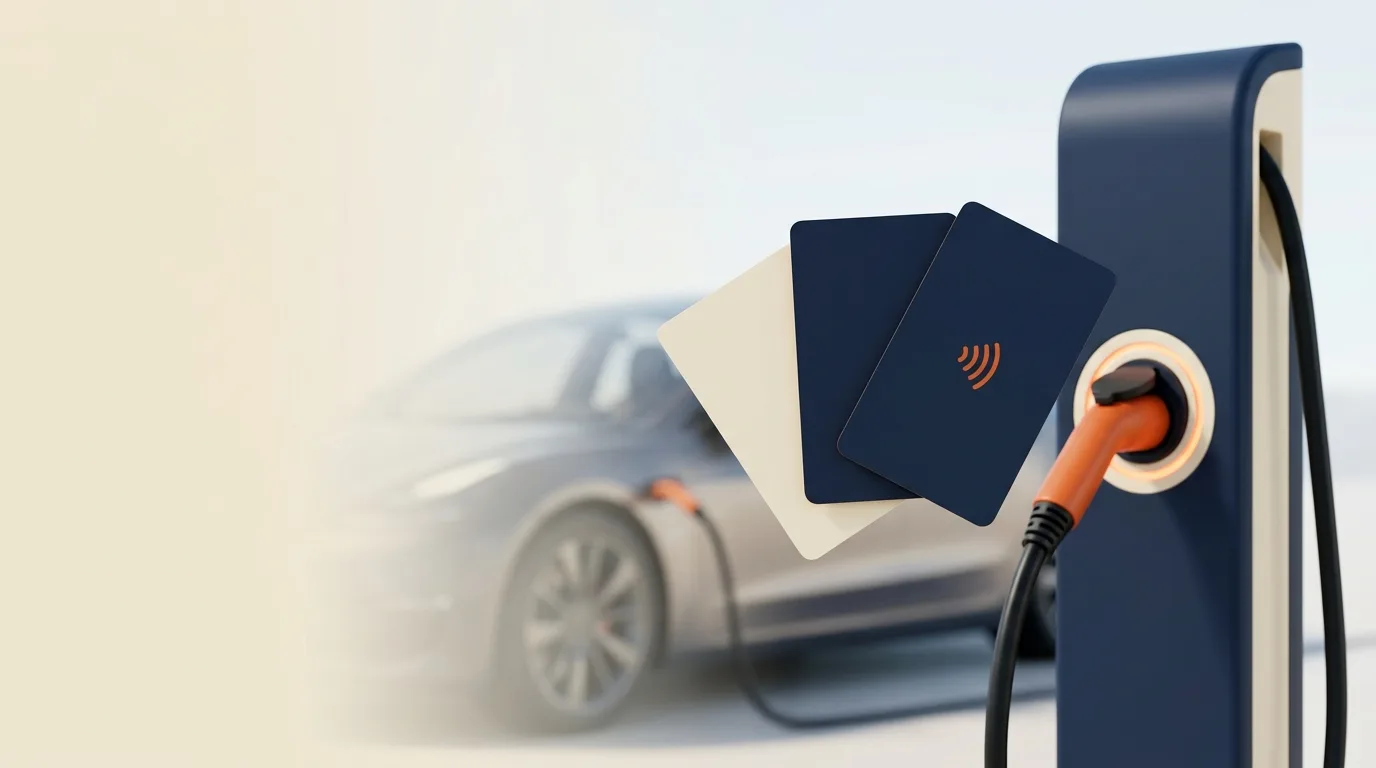
RFID charging cards for your own customer groups

Give private customers, employees, and companies access to your charging infrastructure, even when no one opens the app. Ordering, activation, and billing stay in your brand and in one backend.

  • Access for every customer group
  • Order and activate in the app
  • Billing via the payment profile

How it works

From order to invoice

A card's path is short: order, activate, charge, bill. Every step runs in your brand, with no detour through someone else's portal.

01/ 05

Order in the app or via a form

Your customers pick their card right in the app or through a form on your website.

02/ 05

Receive the card by mail

You ship blank or branded cards, ready-prepared for postal delivery.

03/ 05

Activate in the app

Hold the card to the smartphone (NFC), enter the card number, or scan the code. Instantly linked to the account and ready to use.

04/ 05

Charge at the station

Hold the card to the reader. The station recognizes it and assigns the session to the right account.

05/ 05

Bill automatically

Billing runs through the stored payment profile, bundled into a monthly collective invoice for B2B.

1 of 5
Ordering and onboarding fully inside your app
Card clearly assigned to one account
Blocked within seconds if lost
One backend for private and business customers

Who it's for

One card for every customer group

Not every customer group charges the same way. With RFID cards you serve private customers, employees, and companies from one system, each with the right rules and tariffs.

Customer groups

Who charges with a card

1

Private customers who want it simple or don't have their phone on hand

2

Employees with a company car or a fixed parking spot

3

Companies and fleets with several vehicles and drivers

4

Partners or special groups with their own tariffs and access

Each group gets its own permissions, and you manage everything in one place.

Your card offering grows with you, without making operations more complex.

Activation

Just tap to activate

The favourite way: briefly hold the card to the smartphone to link it via NFC.

Or via card number or QR code, right in your app.

Brand & control

Your card, your customer relationship

The card strengthens your bond with the customer instead of handing them to another provider.

From card design to billing, everything stays in your hands and in your brand.

White-label cards

Blank or printed cards in your design, without an OB7 logo.

Tariffs per group

Every user group gets its own prices and access.

One backend

Private, company, and fleet run through the same administration.

Billing

Two ways a card gets billed

Who pays depends on the customer group. Private customers bill through their own payment profile. Companies bundle their employees' sessions into a single collective invoice.

Two billing modelsPrivate customers·Companies & fleets

B2C: via the payment profile

Private customers

Who it's for

Private customers who charge with a card instead of the app.

How billing works

  • 1The customer stores a payment profile made of a payment method and a billing address.
  • 2Every session with the card runs through that profile.
  • 3Billing happens automatically, with nothing for the customer to do.

Benefit

For your end customers it feels like refueling: tap the card, charge, done.

Typical for: private and family accounts - several cards per account

B2B: as a monthly collective invoice

Companies & fleets

Who it's for

Companies that hand out cards to their employees.

How billing works

  • 1Cards belong to the company, not to the individual person.
  • 2They run through the company's payment profile with a stored billing address.
  • 3All sessions land bundled on a single monthly collective invoice.

Benefit

Instead of many single receipts, the company gets one clean monthly invoice.

Typical for: company cars and fleets - employee charging

  • Cards can be assigned to user groups, for example per site or department.
  • When someone leaves, you deactivate the card with one click.

Which prices and tariffs a customer group gets is set through user groups and tariffs, independently of the individual card.

Control

What you steer in the admin system yourself

You manage cards, rules, and blocks on your own, easy to trace and without a support ticket.

Card products & branding

Define card types, prices, and the design per customer group.

Ordering & shipping

Steer ordering channels, delivery regions, and replacement cards centrally.

Activation & release

Decide how cards are activated and linked to accounts.

Access & user groups

Limit cards to the right groups, sites, or tariffs.

Block & replace

Block lost cards instantly and issue a replacement in a few steps.

Operator questions

Frequently asked questions

Answers about ordering, activation, and billing.

How do our customers order an RFID card?

Right in your app or through a form on your website. Ordering and onboarding run entirely in your brand, and the card arrives by mail.

How is a card activated?

Easiest via NFC: briefly hold the card to the smartphone, done. Or enter the card number in the app or scan the code on the card. The card is then linked to the account and ready to use right away. Without that link, it won't charge.

How does billing work for B2C?

Through the customer's payment profile, meaning the combination of payment method and billing address. Every session is billed to it automatically. More on payment profiles

And how does it work for B2B?

Cards are assigned to the company, not to individual people. All employees' sessions run through the company payment profile and are billed monthly as a collective invoice.

What happens if a card is lost or someone leaves the company?

You block the card instantly in the admin system, and it stops charging. A replacement can be ordered in a few steps, without setting up the process again.

Can several cards belong to one account?

Yes. Typical cases are families with several cards or companies with one card per vehicle or employee.

Can the cards be used for roaming as well?

The focus is on your own customers and your own infrastructure. If an operator takes part in the cross-charging network, the cards work there too.