Configuration per charge point
Fees, base prices, and tariff assignment are set per charge point—for example when AC and DC economics differ or sites have different requirements.
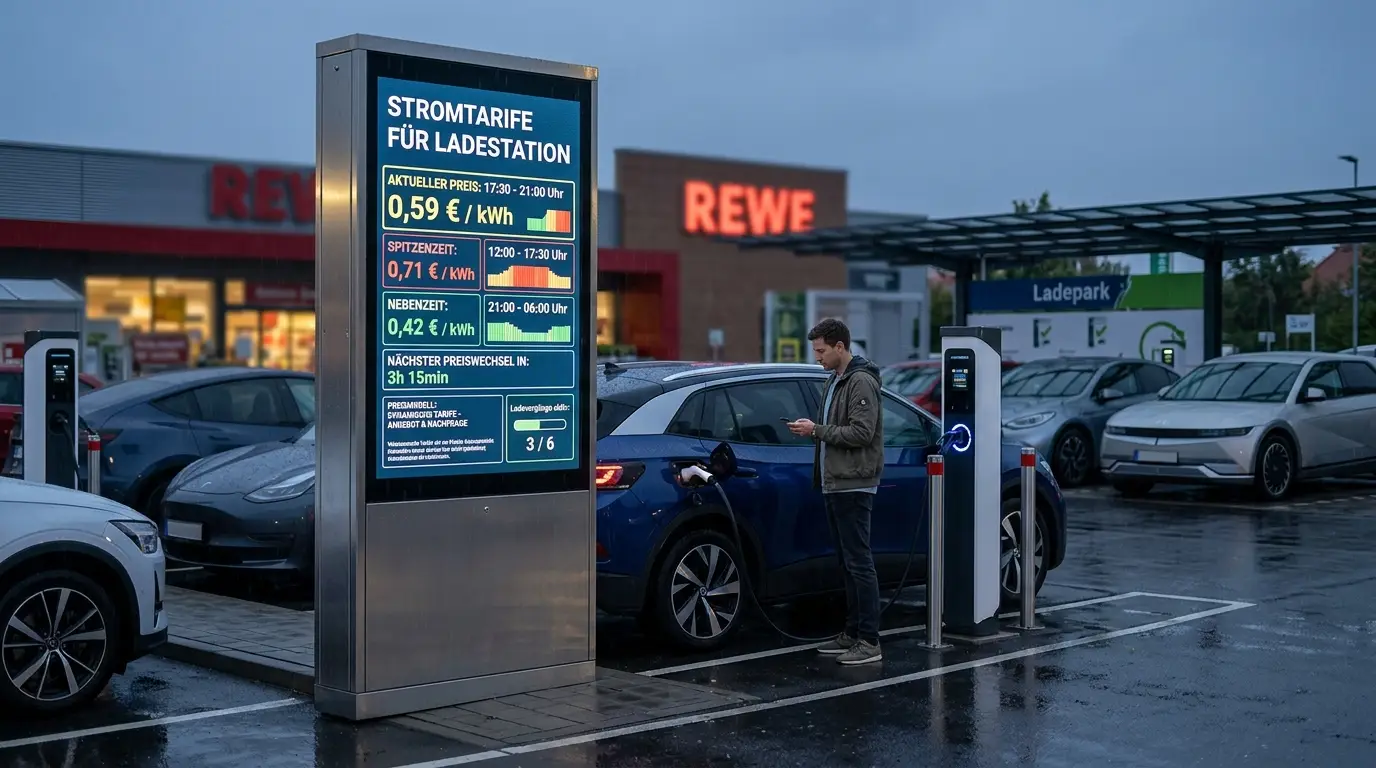
React flexibly to market fluctuations. With dynamic pricing, you automatically adjust your charging tariffs to the current market situation – for higher profitability and better grid utilization.
Transparency & control
You define how your charging prices evolve through the day—with fixed components and variable components from market data. For the market side, we use exclusively EPEX Spot prices  .
.
Configuration
Market data
Exchange power from EPEX Spot—no additional market feeds in this view.
Charge points (simulation)
Three simulated charge points—use the tabs to switch between configurations.
Fees
High solar generation—good conditions for daytime charging.
Preview
Choose the weather scenario and move the mouse over the charts to explore the day (demo).
Day scenario
☀️ High generation → cheaper around midday. ☁️ Less PV → a different daily shape.
Spot component (EPEX)
0.00 ct/kWh
Total charging price
42.00 ct/kWh
Price per kWh = base + spot + per-kWh fee; session start and blocking are spread over 25 kWh reference energy in this demo.
Total price (curve)
Spot component (curve)
Market data: EPEX Spot; weather is only an illustrative knob for the demo curve.
Simplified calculation for demonstration—not a production tariff.
Pricing
You configure fees, base prices, and tariff logic per charge point—and choose whether energy is priced dynamically (e.g. via EPEX Spot) or with a fixed rate. Tariffs can be assigned to user groups; dynamic prices work in the driver app and for ad-hoc QR charging alike.
Fees, base prices, and tariff assignment are set per charge point—for example when AC and DC economics differ or sites have different requirements.
Per product or offer you decide whether the energy price follows the market or stays fixed—regardless of which user group or product sits behind it.
Assign tariffs and dynamic models to user groups—for example a dynamic driver tariff for contract customers and different pricing for ad hoc or fleet users.
For exchange power we use EPEX Spot market information. Variable portions can be bounded with caps and rules in the admin.
End-customer prices are consistent in the driver app and for walk-up charging via QR code; dynamic pricing can be enabled in both channels.
Combine promotion codes and discounts with dynamic prices when it fits your strategy—without overcomplicating tariff logic.
From per-charge-point setup to dynamic pricing in the app and ad hoc.
Dynamic pricing automatically adjusts to external factors such as electricity exchange prices or grid load. This makes it possible to set incentives for charging during off-peak periods.
Pricing is computed in real time from your configured tariff logic and the EPEX Spot market data you select—typically day-ahead prices, and intraday prices where you configure them. You set price floors and ceilings.
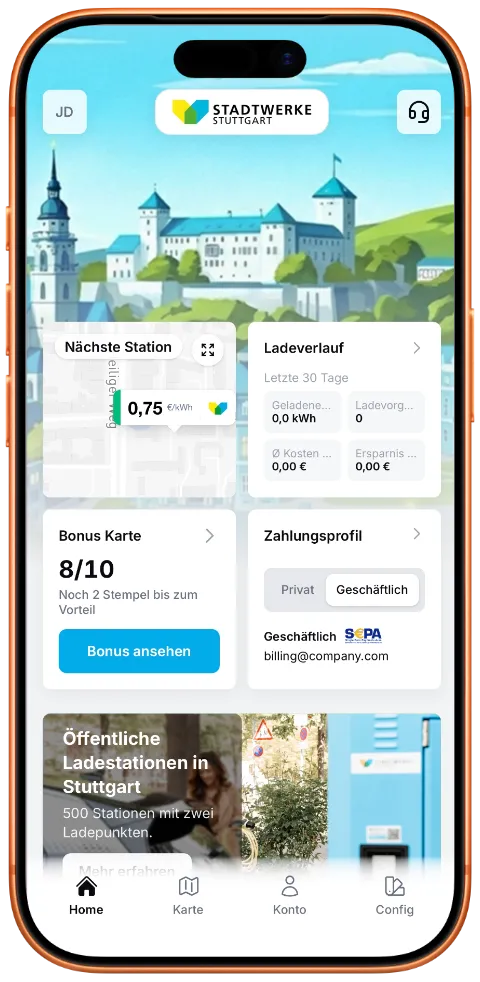
Customers see current prices transparently in the driver app, for ad-hoc (QR) charging, and on the charging station map. Push notifications can highlight particularly low prices. More about the station map
Yes, when the price communicated to the customer at charge start—the price that applies to that session—is binding for the ongoing session and does not change during charging (and must not). OB7 supports transparent price display and communication; compliance with the regulatory requirements that apply to you remains your responsibility.
Yes. You assign tariffs and dynamic models to user groups—for example a dynamic driver tariff for contract customers and fixed or different pricing for ad hoc or fleet users. Dynamic and fixed offers can run in parallel.
We connect to EPEX Spot market data via the MATS API; OB7 is certified as an Independent Software Vendor (ISV) with EPEX Spot. Day-ahead and, where configured, intraday data feed into precise, profitable pricing.
Yes. Session start, blocking, and energy prices—and the choice between dynamic and fixed energy pricing—are set per charge point, for example when AC and DC economics differ or sites have different requirements.
Yes. You can configure dynamic pricing for the driver app and for ad-hoc payment at the charge point. Customers see the current price transparently before the session starts. More about ad-hoc / QR code payment