
For the simplest charging experience in the city
Stuttgart already has one of the densest public charging networks among Germany’s major cities. What is changing now is the comfortable experience behind it: Stadtwerke Stuttgart (SWS), together with software company OB7, have introduced a new ad-hoc charging process for Stuttgart’s public charging network. At more than 1,000 charge points in the city, people can charge without a contract and without prior registration. The aim is to make spontaneous charging noticeably easier, more convenient and more transparent.
City-wide rollout after a successful pilot in Stuttgart-Zuffenhausen
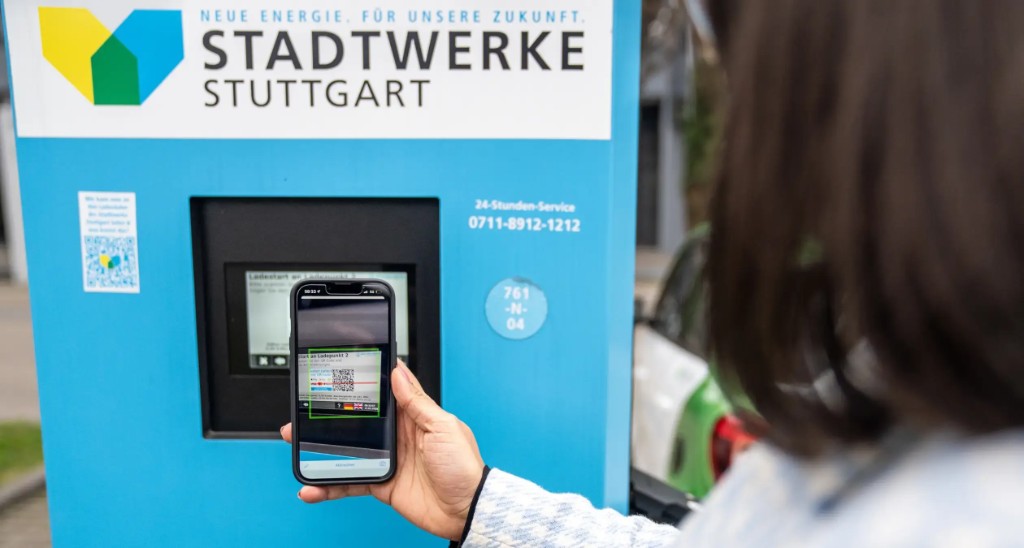
The basis for the city-wide rollout is a joint pilot project at the innovative fast-charging hub in Stuttgart-Zuffenhausen. There, the new ad-hoc charging process was successfully tested and refined. The strength of the joint SWS and OB7 solution for convenient charging is that the session can be started directly at the charge point—without an extra app. Apple Pay, Google Pay and PayPal are linked at the point itself. The new ad-hoc payment option can be used effortlessly from mobile devices via QR code.
Charging start in a few taps
Scan the QR code, check the price, pay with Apple Pay, Google Pay or PayPal, charge, done: in under a minute the charging session is complete—without a contract and without detours. With transparent price display, users always see the current tariff.
Florian Hägele, Head of Charging Infrastructure and E-Mobility at Stadtwerke Stuttgart, says:
“Our shared goal is to expand electric charging in public space to match demand and make it as easy as possible for users. The pilot in Zuffenhausen showed us that the new charging process offers many advantages. Now we are making it available across the city.”
Peter Drausnigg, Managing Director of Stadtwerke Stuttgart, adds:
“Expanding charging infrastructure and keeping usage simple need to be thought about together. With the ad-hoc charging tariff we make public charging in Stuttgart even more practical for everyday use.”
Mobile payment methods are becoming more popular
Early evaluations from operations show that around 70 percent of all transactions are handled via mobile wallets. Apple Pay is the most used method at 45 percent, while classic credit card payments are declining.
Philip Müller, CEO of OB7 GmbH, says:
“Our goal is not only to enable a working charging session, but to create a consistently user-friendly charging experience people are happy to return to. That is exactly what we built our platform for, and we are pleased to implement this standard together with Stadtwerke at the charge points now.”
Stuttgart’s charging network keeps growing
With the state capital’s climate neutrality target in mind, Stadtwerke Stuttgart intend to keep driving charging infrastructure forward vigorously until 2035. The SWS group currently operates 1,400 publicly accessible AC charge points and 63 publicly accessible fast charge points in Stuttgart. Charging uses 100 percent green power from SWS only. The new ad-hoc charging process is another building block to make e-mobility in Stuttgart more practical and user-friendly.